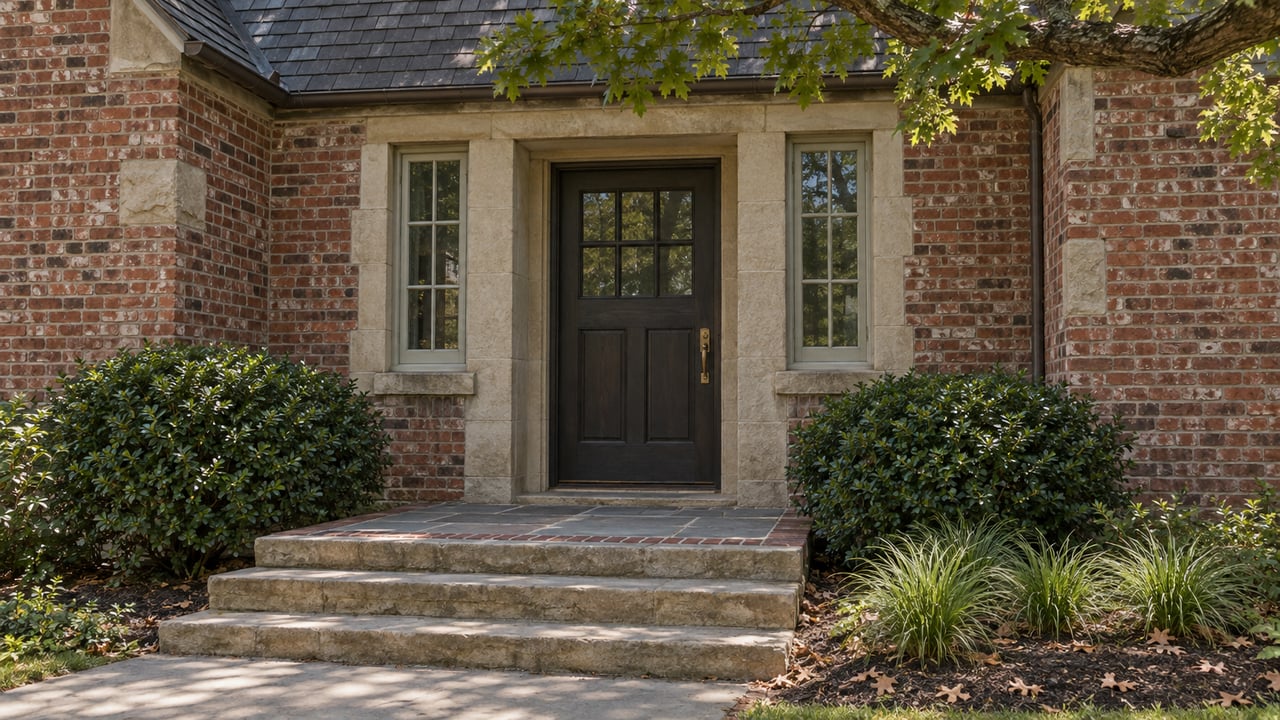
Two nearly identical brick colonials, five miles apart, both inside Elgin's city limits. One sits in Kane County. The other sits in Cook. A buyer comparing them this month might assume the Cook County listing carries the heavier tax bill, because that's the reputation Cook County has across the Chicago suburbs. Pull the actual numbers for Elgin specifically and that assumption falls apart. As of 2026 assessment data, the median effective property tax rate on Elgin's Kane County side runs close to 2.55 percent, while the Cook County side of the same city sits closer to 2.46 percent. The gap is real, but it runs the opposite direction from what most buyers expect, and it's small enough that it isn't the variable that should decide where you shop.
Elgin is one of a small handful of Chicago-area cities split across a county line, spanning Cook and Kane counties along with pieces of five different townships, according to Wikipedia's summary of the city's government structure. Most of the population and most of Elgin's housing stock sits on the Kane County side, in Elgin, Plato, Rutland, Dundee, and Campton townships. A smaller slice sits in Hanover Township, Cook County, on the city's eastern edge. The line exists on tax maps and parcel records. It does not, on its own, tell you what you'll pay.
Two different math machines, similar answers
Illinois counties don't all calculate property tax the same way. Kane County, like the rest of the state outside Cook, assesses residential property at roughly one third of fair cash value, then applies a small state equalization factor to land on the Equalized Assessed Value that your bill is actually based on, a process the Elgin Township Assessor's office lays out in detail for homeowners. Cook County runs a different model. It assesses residential property at a much lower fraction of market value and offsets that with a far larger equalization multiplier, plus its own local levies stacked on top.
Two different formulas, run on two different starting numbers, are producing effective tax rates in Elgin that land within about a tenth of a percentage point of each other in 2026. That's the part worth sitting with. A buyer who avoids the Cook County side of Elgin on the assumption that it's the pricier tax jurisdiction is optimizing for a gap that, at today's rates, barely exists.
Where the two systems actually diverge is in how often they update. Cook County reassesses property on a rotating triennial cycle, split by region, so a given township's assessed value gets revisited every three years. Kane County and the rest of Illinois's collar counties are required to reassess every four years, a distinction spelled out in the Civic Federation's ongoing analysis of collar county tax rates. That difference doesn't change what you pay on day one. It changes how often the number can move under you, and Cook's shorter cycle means a Hanover Township homeowner in Elgin will see a fresh assessed value more often than a neighbor two miles away in Elgin Township, Kane County.
The exemption that runs backward from expectation
Illinois offers homeowners a General Homestead Exemption that reduces the Equalized Assessed Value before your tax rate is applied to it. Most buyers assume this exemption is uniform across the state, or that Cook County, with its reputation for high taxes, would offer less relief. It's the reverse. The exemption is worth up to $10,000 of EAV in Cook County. In Kane County and the other counties that border Cook, it caps at $8,000, according to the Illinois Department of Revenue's own property tax relief guidance.
On a home in an 8 percent composite tax district, that $2,000 difference in exemption value works out to roughly $160 a year, favoring the Cook County side.
The Senior Citizens Homestead Exemption doesn't follow the same pattern. That one is set at $8,000 of EAV in Cook County and every county that touches it, Kane included, so seniors get the same treatment regardless of which side of Elgin they're on. It's specifically the general, all-owner-occupant exemption where the county line works in the Cook County buyer's favor rather than against it.
Filing mechanics differ too. Cook County's homeowner exemption is generally auto-renewed once it's on file. In Kane County, the standard practice is a one-time application that then continues automatically each year without re-filing, per Kane County's own assessment office guidance. Neither system is harder than the other. They're just administered by different offices, and a buyer moving from one side of Elgin to the other needs to know which office to file with, not assume the paperwork from their old address will follow them.
The boundary that actually moves the number
If the county line isn't the thing to watch, the school district lines are. Most of Elgin sits inside School District U-46, the second largest district in Illinois. But western and southwestern edges of the city fall outside U-46 entirely. Community Unit School District 301, based in Burlington, serves a slice of Elgin's western edge. Community Unit School District 300, based in Carpentersville, picks up part of the northwest. Community Unit School District 303, based in St. Charles, covers part of the southwest. None of these boundaries track the Cook-Kane county line. A buyer can stay entirely inside Kane County and still cross from U-46 into CUSD 303 depending on which block they're looking at, and school district levies are one of the biggest line items on any Illinois tax bill.
Zip codes complicate the picture further rather than simplifying it. Elgin's 60120 zip code, one of the city's largest, isn't even a single-county zip. Mapping data shows it spans Cook, Kane, and DuPage counties simultaneously, touching Bartlett, Hoffman Estates, Streamwood, South Elgin, and Wayne along its edges. Two houses that share a zip code and a mailing address format can sit in different counties, different townships, and potentially different school districts, all without the buyer noticing until the tax bill or the assessment notice arrives.
What this means while you're actually shopping
Elgin's housing market has stayed active through 2026. Listings in the city have been moving at a median of around 25 days in September, and average home values were running about 4 percent higher year over year as of late August, consistent with a market where demand hasn't slowed even as prices have leveled off from their spring peak. In a market moving that fast, parcel-level detail is the most useful thing to have in hand before an offer, and it can be gathered in a few short steps.
The practical fix is simple and doesn't require a spreadsheet. Before you fall for a listing, ask which township the parcel sits in, not just which county, since township determines the reassessment clock. Ask which school district serves that specific address, since that boundary cuts across the county line without warning. And when you're comparing the homestead exemption on two properties, check the actual dollar figure filed against each one rather than assuming one county's number automatically applies. The county line on the map is real. It's just not the line that decides what you'll owe.
A few direct questions
Does the county line affect my mortgage or my closing process in Elgin? No. Financing, title work, and closing procedures follow Illinois state law and don't change based on which county a Elgin parcel sits in. The county line affects assessment, exemptions, and reassessment timing, not the transaction itself.
How do I find out which county, township, and school district a specific Elgin address falls under? The parcel identification number on any county assessor's website will show the township and taxing bodies attached to that property, and the seller's disclosure or listing sheet should note the school district. When in doubt, the two county assessment offices, Kane County's and Cook County's, can confirm which jurisdiction a specific address falls under before you write an offer.
Buying in a city split by a county line rewards the kind of parcel-level homework most buyers skip. If you're weighing two Elgin properties and want a straight read on what each one's tax and exemption picture actually looks like before you write an offer, reach out to Holzl Homes and request your free home valuation.