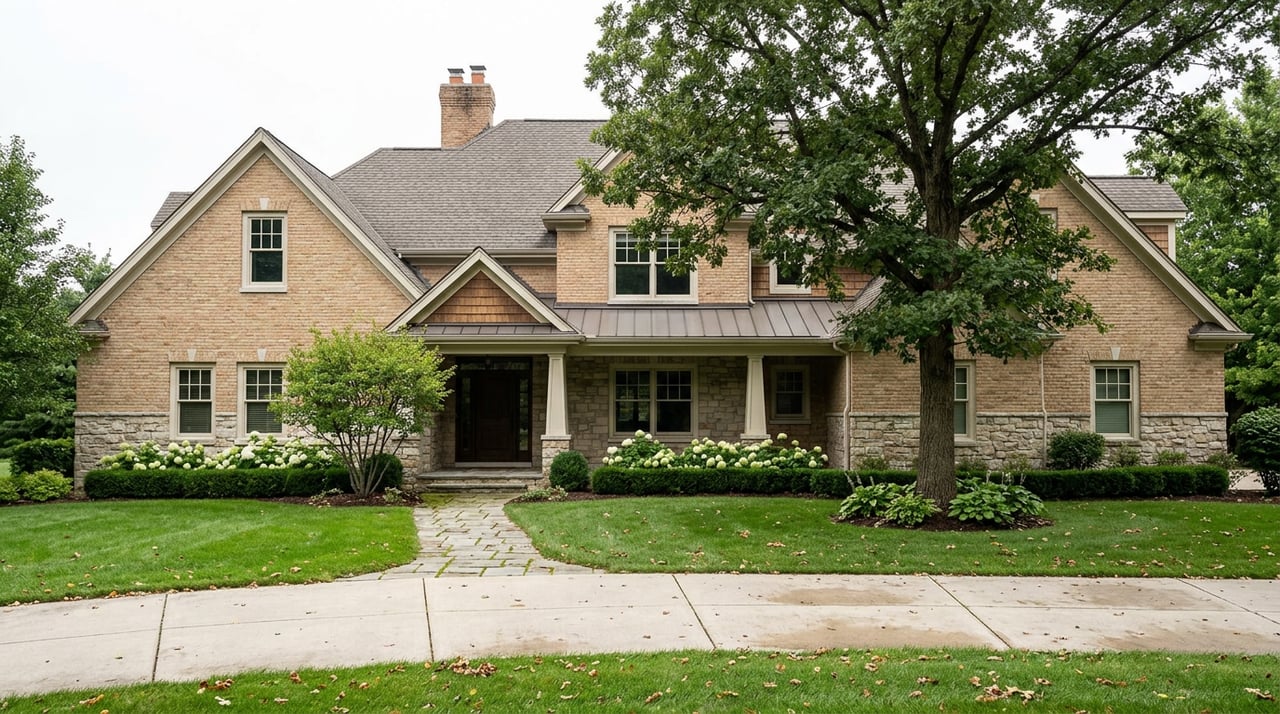
If you've been watching listings in North Aurora, you've probably run across the number by now. The village's median sale price climbed 23.7% year over year in December 2025, landing at $440,000. That kind of jump usually means one of two things happened. Either every home in the village got meaningfully more valuable in twelve months, or the number is telling you something else.
It's the second one. North Aurora is a village of roughly 16,000 people, and in the month that produced that headline stat, exactly 21 homes sold. The December before, 18 sold. A swing of three transactions, in a market this small, can move a median price by tens of thousands of dollars without a single home actually appreciating anywhere near that fast. That isn't a flaw in the data. It's just what happens when a village gets measured with big-city statistics.
The Sample Size Problem Nobody Mentions
Here's the part that should make you pause before treating that 23.7% figure as a temperature reading on the market: while the median dollar price jumped, homes actually took longer to sell, 65 days on average in December 2025 compared to 41 days the year before, and the price per square foot fell 8.1% over the same stretch. A market that's simultaneously getting "more expensive" by the median, taking longer to close, and losing value per square foot isn't behaving like a hot market. It's behaving like a market where the mix of what sold changed, not the value of what's already standing.
A village where twenty-one closings can move the median by five figures isn't a market you read in one number. It's a market you read by neighborhood.
That's the thesis worth carrying into any comparison shopping you're doing between North Aurora and its neighbors along the Fox River. The village-wide median is real. It's just not the number that tells you what your money buys.
Two Very Different North Auroras
Here's the mechanism behind the swing. North Aurora isn't one housing market wearing one price tag. It's at least two, and which one happens to close in a given month decides what the headline number looks like.
On one end sits Tanner Trails and the adjacent Reserves at Tanner Trails, an estate-feel section where lots average more than 10,000 square feet and homes sit well back from the road. The location trades on access: close to I-88, Orchard Road, and Randall Road, with two Metra stations a short drive away. These are the homes that pull the median up when several of them close in the same month.
On the other end are the village's older, more established pockets, like Oak Creek, where housing stock tends to run smaller, older, and more within reach for a first-time buyer. When the month's closings lean this direction instead, the median pulls back down, even if nothing about the underlying market actually cooled.
In between runs the Randall Road corridor, the commercial and residential spine of the village, where new construction keeps adding inventory. Lennar is currently the most active builder in North Aurora, and communities like Moose Lake Estates are offering build-to-order homes with easy reach to Batavia, Geneva, and St. Charles. Autumn Ridge, built out in 2025, shows what recent-vintage inventory looks like for buyers who want new construction without the wait for a to-be-built lot.
None of this means the 23.7% figure is wrong. It means the figure is describing a mix, not a trend, and the mix can flip from month to month in a village this size.
What the Year Actually Looked Like, Month by Month
A single year-over-year comparison flattens a market that moved quite a bit over the course of 2026. Here's how the picture shifted as the year went on:
| Period | What the data showed | What it means |
|---|---|---|
| February 2026 | Inventory near 13.8 months of supply | A clear buyer's market, with overpriced or dated listings piling up unsold |
| April 2026 | Median list around $499,000, median sold closer to $450,000, days on market down to 30 (a 21% drop from April 2025) | Spring buyers arrived and split the market: well-priced, move-in-ready homes moved fast while others kept sitting |
| August 2026 | Median list around $468,000, $225 per square foot, homes moving in a median of 24 days, matching the same month a year earlier | The market held a brisk, steady pace into late summer rather than accelerating further |
Read across that table and the story is less "prices are soaring" and more "the village spent the first quarter working through a glut, then settled into a pace that's brisk for well-prepared listings and considerably slower for anything overpriced or dated." That's a different, more useful thing to know if you're timing an offer.
The Tax Line That Changes the Real Number
Here's where the comparison to neighboring suburbs gets more expensive than a portal search filter will show you. Kane County's property tax structure means the actual monthly cost of moving up a price bracket in North Aurora runs steeper than the sticker price suggests.
North Aurora specifically carries an effective property tax rate near 2.57%, with a median annual tax bill around $6,920. Run that against a $450,000 home and you're looking at roughly $11,500 a year, close to $960 a month, stacked on top of principal, interest, and insurance. For a lot of buyers, that's the actual difference between qualifying for a $450,000 home and a $400,000 one, and it needs to be in the budget from the first pre-approval conversation, not discovered at closing.
There's relief available but it isn't automatic. Illinois' General Homestead Exemption reduces a home's equalized assessed value by $8,000 for an owner-occupied primary residence, and it has to be filed for, not assumed.
Zoom out to the countywide level and the picture gets messier in an informative way. Depending on which methodology you check, Kane County's effective property tax rate is estimated anywhere from about 2.2% to 2.7%, and SmartAsset's analysis puts the typical Kane County bill just below neighboring DuPage County's but still well above the state median. The spread exists because Kane County layers taxes through more than 600 separate tax code areas, each combining a different mix of school district, park district, library district, and township levies. Two homes a few blocks apart, split by one of those boundary lines, can carry noticeably different bills even at similar market values.
What This Means If You're Comparing North Aurora to Its Neighbors
The village-wide median is a fine headline. It's a poor tool for deciding what to offer on a specific house. Two questions do more work than the median ever will: which pocket of town is this listing actually in, estate-lot new construction, an older established block, or something along the Randall Road corridor, and what taxing districts overlap this specific parcel. Those two answers explain more about your real monthly payment than a single village-wide number.
Timing matters too. The move from 13.8 months of supply in February to a 24-to-30-day market by summer suggests the window for negotiating room on overpriced or dated listings has narrowed as the year has gone on, even as well-priced, move-in-ready homes in either submarket haven't had trouble finding buyers.
A Few Direct Questions
Is North Aurora a buyer's market or a seller's market right now? Neither, uniformly. As of August 2026, homes were moving in a median of 24 days, matching the same period a year earlier, which points to something close to balance for priced-right homes. But the swing from 13.8 months of supply back in February shows how quickly conditions can move within a single village.
Why do two North Aurora homes end up with such different tax bills? Because Kane County taxes flow through more than 600 distinct tax code areas covering school, park, and library districts among others. Two homes close together but on opposite sides of one of those boundaries can carry different bills even with comparable market values.
Should I expect the same price per square foot in Tanner Trails and Oak Creek? No. The estate-lot sections built for buyers who want more land and highway access sit at different price points than the village's older, more compact housing stock, and that difference in mix is a large part of why the village-wide median moves as much as it does from month to month.
North Aurora rewards buyers who look past the headline number and ask which submarket, which tax code area, and which season they're actually shopping in. That's the kind of read that comes from working this specific stretch of the Fox Valley every week, not from a single portal snapshot. If you're weighing North Aurora against Batavia, Geneva, or St. Charles and want the real numbers behind a specific address, Holzl Homes can walk you through it. Request your free home valuation and start with the number that actually applies to you.